
Trace Anderson County Former Owners by Transfer
A transfer is the anchor, not a list of names. Start with the newest grantee and legal description you can confirm. Then work deed by deed into the past. Anderson County publishes no official online grantor-grantee index. So recent deed records may require a phone call, email, mail request, or a counter visit to the Register of Deeds. The documented historical series adds real depth. A chain may reach the nineteenth or early twentieth century. Once it does, the archival deed records open up.
| Source | Years It Covers | Where Held | What It Shows |
|---|---|---|---|
| Current recorded deeds | Current cutoff not published | Anderson County Register of Deeds | Grantor, grantee, description, recording reference |
| KSHS deed record | 1857-1902 | Kansas State Archives | Recorded transfers in the historic deed series |
| KSHS related index | 1857-1911 | Kansas State Archives | Name routes into historical volumes |
| Plats, maps, and federal tract records | Varies by series | KSHS, recorder, and BLM sources | Original land, subdivision, lot, and tract context |
For a modern chain, contact the county office first and ask how its later index is searched. For an early chain, use the Anderson County archival collection and the KSHS land-record guide. Neither a tax roll nor a directory substitutes for the recorded transfer itself.
Build an Anderson County Deed-Chain Timeline
A working timeline should preserve both names and record keys. Street addresses change. Parcels split. An owner's name can even be indexed in a different order. The legal description and recorder reference keep every link in the deed chain tied to the same piece of Anderson County land.
| Transfer date | Grantor to grantee | Deed type | Book, page, or instrument |
|---|---|---|---|
| Newest recorded date | Prior owner to current grantee | As recorded | Copy exactly |
| Earlier recorded date | Earlier grantor to prior grantee | As recorded | Follow any prior reference |
| Historic entry | Indexed historic parties | As shown in volume | Book and page |
Record the recording date separately from the date an instrument was signed. When names, acreage, or descriptions shift between deed records, note the discrepancy instead of forcing a match.
Request Later Anderson County Ownership Records
The Anderson County Register of Deeds is the route for deeds outside the KSHS series. Sandra J. Baugher serves as Register. Connie S. Peine is Deputy. The office sits at 100 East Fourth Avenue in Garnett, and lists 785-448-3715 and regofdeeds@andersoncountyks.org. Weekday hours run 8:00 a.m. to 5:00 p.m. Give the office the property address, known party names, date range, legal description, and any KSPID, book/page, or instrument number you have. Ask for the latest deed and its cited prior instrument. Ask the copying or certification cost too. An email or phone call can establish the search and price before a mail or counter request for Anderson County deed records.
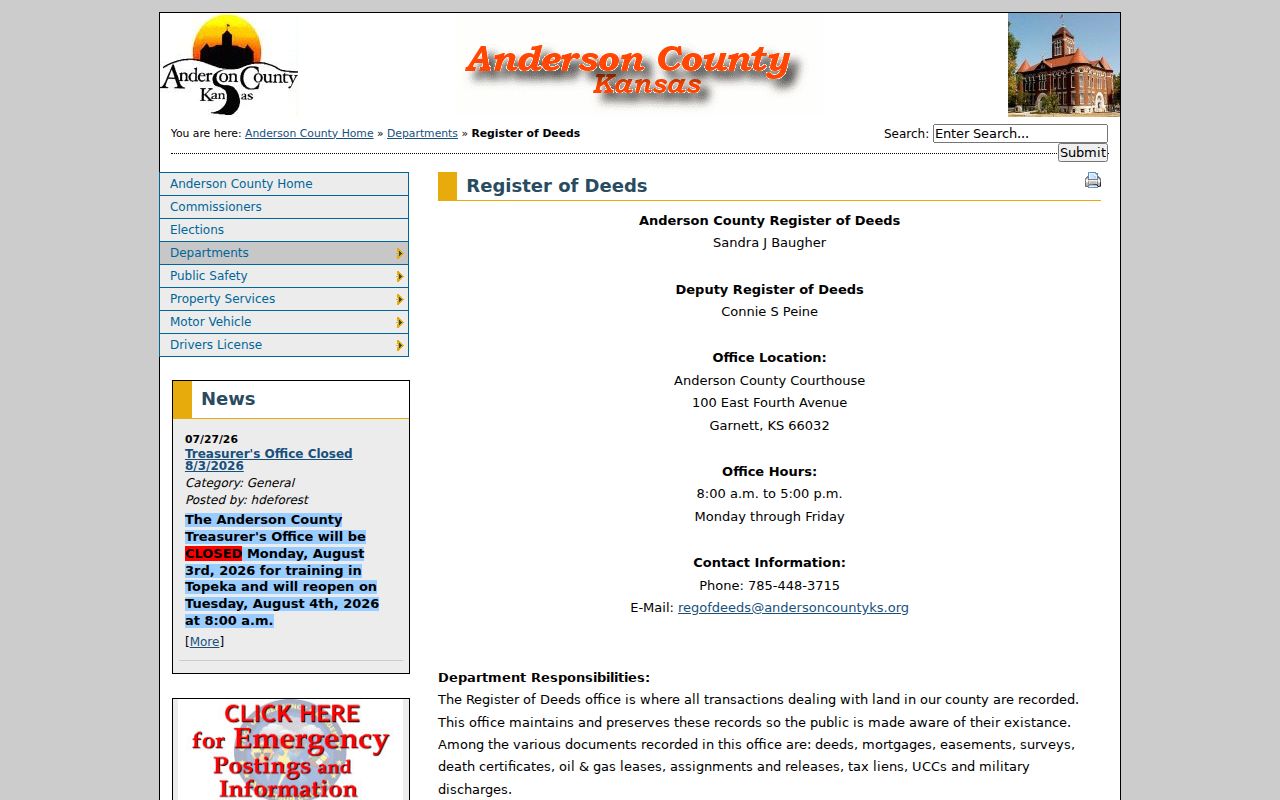
The Register of Deeds is the confirmed custodian, with a clear contact path. The county publishes no searchable online deed index, so requests go through the office directly.
Note: The Treasurer lists courthouse doors locking at 4:30 p.m., so plan a counter visit before the office's posted closing time.
Walk Anderson County's Grantor Trail in Reverse
Read the newest deed first. Its grantee is the buyer. Its grantor conveyed the land. That grantor then becomes the next grantee name to search further back in the Anderson County deed chain, while you check that each instrument carries the same or a clearly evolved legal description.
- Identify the latest deed in which the present holder appears as grantee.
- Copy its grantor, legal description, recording date, and prior-reference details.
- Search that grantor as an earlier grantee and verify the same tract.
- Repeat until the later index ends, then continue in the KSHS index and deed volumes.
- Grantor / grantee
- The conveying party and receiving party named in a deed.
- Chain of title
- The ordered sequence of instruments that connects ownership through time.
- Reverse index
- An index organized to find conveyances from the party who granted an interest.
- Warranty / quitclaim deed
- Different deed forms whose effect must be read from the instrument, not guessed from the label.
Follow Anderson County Parent Tracts Through Splits
A present parcel may not have existed in its current shape when former owners held the land. Anderson County's parcel-split and subdivision forms call for a deed, certificate of survey, legal description, and easement material when applicable. Those documents can tie a new parcel to its parent tract even when the KSPID or street address differs. Match acreage, section-township-range calls, lot and block, subdivision name, road exceptions, and adjoining descriptions. Planning and Zoning files, recorded plats, and the deed chain should agree on how the land was divided. A map identifier alone should never be pushed backward past the date it was created.
Use Anderson County's Earlier Place Names
Historic place names are practical search keys for Anderson County deed records. The county seat moved from Shannon to Garnett in 1859. Colony was formerly Divide. Greeley's post-office history runs through Mount Gilead. A former-owner search limited to today's town name can miss a deed. It can also miss a directory entry, newspaper notice, or plat reference. The KSHS post-office chronology helps translate those old place references. Use the historic name as an added hypothesis. The legal description stays the controlling land identifier.
Separate Anderson County Occupancy From Title
Census indexes, local directories, newspapers, cemetery records, and probate files can explain who lived on or was tied to a property. They are valuable context. None alone establishes a transfer. A probate order may explain authority, yet the recorded executor or heir conveyance is the link that belongs in the Anderson County deed chain. KSHS also points researchers to plat atlases, federal tract books, and Bureau of Land Management General Land Office material for original public-land context. A KU Spencer Research Library collection holds an 1865 Anderson County warranty deed as a primary-document lead. These sources enrich the history. Recorder instruments remain the backbone of the property records.
Repair Anderson County Chain Breaks After an Estate
An estate interrupts the tidy rhythm of one seller, one buyer. Anderson County's archival holdings include probate material. A FamilySearch catalog lists a general probate index covering 1857 through 1976. Treat these as finding aids. They point to the authority behind a transfer. They are not the recorded conveyance that actually moved the land.
Start with the decedent or estate name. Search it in the probate index. Try the Kansas Courts public portal if the matter is recent enough. That portal lets you search by party, business, case number, citation, date, status, and case type. Restricted cases and document access limits apply. The Anderson District Court Clerk offers a courthouse terminal. A clerk-request path is also available at 100 E 4th in Garnett.
Then circle back to the recorder. The probate order explains who held authority. An executor's deed, administrator's deed, heir deed, survivorship deed, or similar instrument does the actual transferring. Match the exact legal description and the recording reference every time. A death certificate or obituary can settle identity, yet neither transfers real estate by itself.
Score Each Anderson County Former-Owner Link
A dependable chain separates proven links from useful leads. Call a former owner confirmed only when an indexed or recorded instrument matches the tract. It should also match the party role. A link is probable when a deed reference exists. Its image or description may still need review. Directories, census entries, and newspaper notices stay contextual until a recorded transfer ties them in. This scoring keeps a plausible historic resident from being mistaken for a previous owner. It also leaves each unresolved gap visible to the next researcher.
| Confidence | Evidence | Next action |
|---|---|---|
| Confirmed | Recorded deed plus matching legal description | Continue with its grantor or prior reference |
| Probable | Index entry with matching names and date | Request the instrument image |
| Context only | Directory, census, obituary, or tax mention | Find the deed or probate conveyance |
| Unresolved | Name, acreage, or tract mismatch | Check plats, splits, aliases, and old place names |
Score every Anderson County former-owner link the same way. Confirmed, probable, or contextual: those three labels keep the chain honest. The method also exposes each gap openly for the next researcher to resolve.
Measure the Depth of Anderson County Ownership Records
The documented KSHS deed record for Anderson County begins in 1857 and runs through 1902. A related index reaches 1911. That span is a concrete historical range. It is not a cutoff for every deed the county holds. Ask the Register of Deeds how a chain moves from newer office records into those archival volumes. Ask for the current later-index start date and any remote image access.
At the earliest end, federal patents, tract books, and railroad land records can identify the first disposition from the public domain. At the newest end, trust the latest recorded conveyance over an older parcel-map label. Document every gap and source date. That habit keeps a tentative former owner from being presented as proven.
Lawful use. Former-owner research supports house history, estate work, and property diligence. It must never be used to track, intimidate, or harass a living person.