
Read Anderson County Property Tax Records
A full Anderson County tax check touches three offices. The Appraiser fixes value and classification. The County Clerk finalizes assessed values and the tax roll once levies land, while the Treasurer bills, collects, tracks payment status, and answers delinquency questions. Those separate duties explain why one parcel holds several valid Anderson County property records with different dates.
| Tax record field | What it answers | Official keeper |
|---|---|---|
| Appraised value | County estimate under valuation rules | County Appraiser |
| Assessed value | Value after the statutory class ratio | Appraiser and Clerk roll |
| Classification | Actual-use class as of January 1 | County Appraiser |
| Levy and special assessments | Rates and added charges used for tax | County Clerk and taxing units |
| Bill, payments, delinquency | Amount due and account status | County Treasurer |
Appraised value is not the bill. Assessed value, levies, special assessments, credits, and payment status together determine the tax due, and none of them predicts a sale price.
Anderson Tax Offices Have Separate Jobs
County Appraiser Adam Wilson works from the Annex at 409 South Oak Street in Garnett. The office values property. It neither sets levies nor collects taxes. The Appraiser page says as much while linking ORKA, the valuation calendar, and the market study.
Treasurer Ida McClelland and Deputy Harold DeForest serve at 100 East Fourth Avenue, Room 2, listed at 785-448-5824 and treasurer@andersoncountyks.org. Hours run 8:00 a.m. to 5:00 p.m. The courthouse doors lock at 4:30. The Clerk handles roll administration and special assessments after levies are set.
Value Questions
Ask the Appraiser about classification, appraised and assessed value, property record cards, evidence, and appeals.
Bill Questions
Ask the Treasurer about statements, receipts, payment status, delinquency, special assessments, and tax-sale status.
Look Up an Anderson Tax Bill
The county posts a Kansas.gov tax-payment handoff for online tax bills. Select Anderson County first. Credit cards and e-checks both work for current taxes. The live account fields, convenience fee, statement history, and receipt features appear on the Kansas.gov screen, so keep the parcel address and all official identifiers close.
- Locate the parcel in ORKA and copy KSPID, PropertyID, QuickRefID, and legal description.
- Open the county payment handoff, select Anderson County, and follow the current account prompts.
- Confirm the tax year, parcel match, amount due, and any payment status before paying.
- Ask the Treasurer about prior years, delinquency, special assessments, or receipts that are not shown.
- Compare value and exemption questions with the Appraiser record, not the payment screen.
TxID and ParcelID appear on tax-sale notices. Neither is a proven stand-in for KSPID or QuickRefID, so preserve each source label and any leading zero.
Anderson Online Tax Payment Handoff
The county payment page bridges to the Kansas County Treasurers Association service. It confirms online access. It lists the stated payment methods but promises nothing about which search fields appear after the handoff, and the Anderson County online tax page shows the official route.
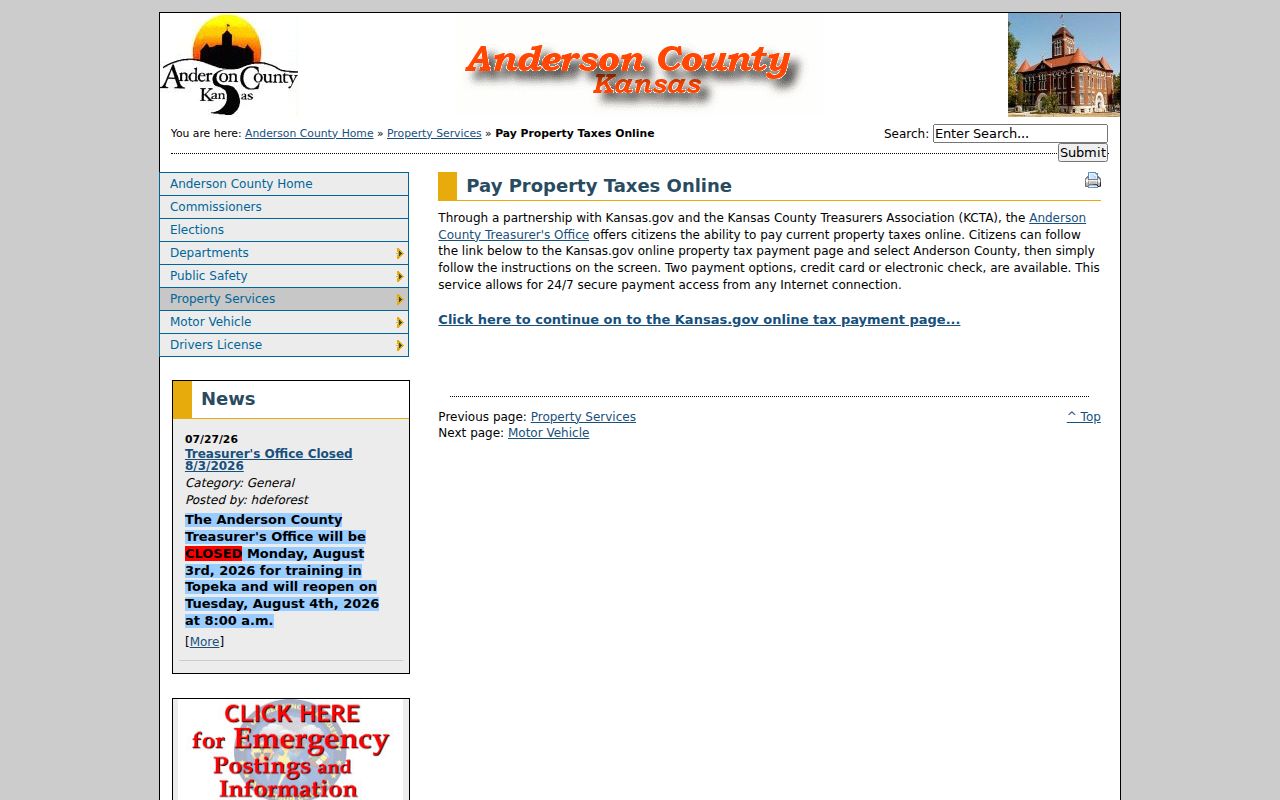
Use the page to enter the current system. Then verify the parcel, year, service fee, and payment result on the live screen. If anything differs from the account, contact the Treasurer.
Track the Anderson Property Tax Calendar
Kansas sets January 1 as the valuation date. The county mailed value notices March 1, 2026. The county calendar lists March 31 as the real-property appeal deadline, while the notice text itself says April 1. Keep that one-day conflict intact rather than smoothing it over, and confirm the controlling deadline in writing with the Appraiser.
| January 1 | Valuation and actual-use classification date |
|---|---|
| March 1 | 2026 real-property value notices mailed |
| March 31 or April 1 | Conflicting local 2026 appeal references; confirm |
| June 15 | Appraisal roll certified to County Clerk |
| November 1 | Roll certification to Treasurer |
| December 20 | First-half tax payment |
| May 10 | Second-half payment |
Weekends can shift a due date. A legal holiday does the same where the rule applies, pushing payment to the next business day. Always rely on the notice and the county's current instructions for the tax year at issue.
Understand Anderson Assessed Values
Kansas classification ratios turn appraised value into assessed value. Residential property sits at 11.5 percent. Vacant lots sit at 12 percent. Commercial and industrial property carry 25 percent, several other classes carry 30 percent, and qualifying agricultural land runs on agricultural-use value instead, commonly at a 30 percent ratio.
- Appraised value
- The county's value under Kansas valuation rules.
- Assessed value
- The taxable base after the statutory classification ratio.
- Levy or mill rate
- The rate applied to assessed value by taxing jurisdictions.
- Special assessment
- A separate charge added through an authorized local process.
- Tax lien
- A claim tied to unpaid tax that requires current status review.
Classification follows actual use on January 1. Zoning labels and owner plans do not control it. A mixed-use parcel may be split by use, and agricultural use value is not a forecast of what the land would fetch if converted.
Anderson County's 2026 Market Signal
The 2026 county market-study statement reports annual inflationary increases for older homes built before 1946, newer homes built after 1945, and commercial property overall. Vacant land is described as stable. The statement publishes no numeric percentage. It offers no city-by-city rate either.
This is context for an Anderson County property tax record, never a parcel estimate. The study cannot show how one Garnett house, one Colony lot, or a Greeley-area farm changed, and a parcel answer needs the property record card, class, condition, neighborhood, use, and the valuation year's evidence.
The Appraiser's role gets misread often. The office values property but sets no levies and collects no tax. That split is the whole map. A value concern goes to the Appraiser; a paid-or-due question goes to the Treasurer.
Review Anderson Tax Exemptions
Kansas exempts public property, cemetery property, and other statutory classes. A residential rule beginning with 2024 goes further. It exempts the first $75,000 of appraised value. The exemption applies to the statewide school-finance mill levy for qualifying property. That relief is real but narrow. It does not remove the whole parcel from local taxation. The Kansas property-tax exemption page supplies official categories and current guidance.
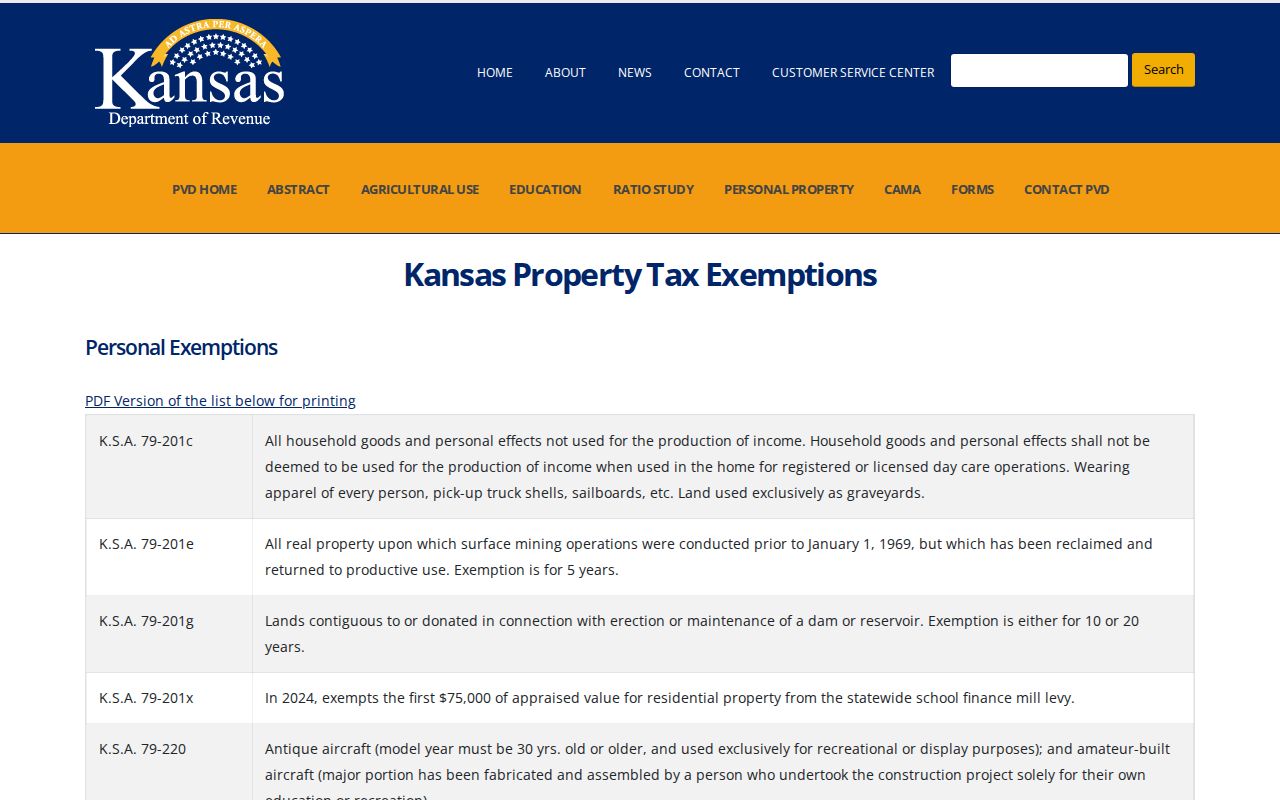
The Kansas Homestead K-40H rebate is separate. It stands apart from parcel title and general exemption status, and rules change, so use the current state form rather than inferring eligibility from an ORKA owner label.
Read Anderson Delinquent Tax Notices
Anderson County's most recent delinquent tax sale was scheduled for March 30, 2026. It was set for the county Extension Office. Each item on the notice carries its TxID, ParcelID, and legal or property references. The notice also lists registration details and payment terms. Bidders with unpaid Anderson County taxes were barred. No next sale date has been announced.
A sale list is a snapshot. It is an auction lead, nothing more. A listing does not prove a sale closed. It does not show a redemption expired, a tax deed issued, or ownership changed. Match the list ID to ORKA and the legal description. Then ask the Treasurer about payment and redemption status. Ask the recorder about any later deed or release, and the court when litigation is indicated.
Start with the Anderson County tax-sale schedule for current status. Never gauge title quality or redemption rights from a list alone.
Challenge an Anderson County Assessment
Kansas gives taxpayers two ways to fight an assessment. One is an equalization appeal after a value notice. The other is a payment-under-protest route. Spring appeals move fast. Contact the County Appraiser within 30 days of mailing. An informal meeting comes first, with an exchange of evidence. Bring the property record card, photos, condition facts, and the correct class and use. Also bring comparable evidence and proof of any data errors.
- Read the value notice and preserve its mailing date.
- Confirm the local deadline because the 2026 county sources differ by one day.
- Request the property record card and the evidence used for value.
- Attend the informal meeting and retain the county decision.
- Review the current Board of Tax Appeals deadline and eligibility after the decision.
Appeal date conflict. Anderson County's 2026 calendar says March 31 while notice text says April 1; confirm the deadline with the Appraiser.
Payment under protest is filed with the Treasurer at the time you pay under the state process. Sequence matters here. Kansas warns against assuming both appeal routes can be used for the same property and year.
Limits of Anderson Property Tax Records
A tax record has limits. An Anderson County property tax record does not prove current ownership, a clear chain of title, a surveyed boundary, or a market sale price. Do not ask the Treasurer to certify title. The Appraiser won't state the current amount due.
ORKA's accessible sample still shows 2017 tax-year fields, even as the county Appraiser discusses 2026 notices. Trust the fresh value card. A current Treasurer account outranks both for balance due, so label every number with its office and year.
KORA can supply existing nonexempt records. The office need not build a custom tax analysis, so ask for a specific statement, receipt, roll entry, appeal decision, or completed form.