
Anderson County Deeds by Type
The Anderson County Register of Deeds handles far more than deeds. The office also records mortgages, easements, surveys, oil and gas leases, assignments, releases, tax liens, and UCC filings. Deed type hints at how an interest moved. The full instrument language governs its true effect.
| Deed type | What it generally does | Common record use |
|---|---|---|
| Warranty deed | Conveys the stated interest with covenants | Ordinary sale and title chain |
| Quitclaim deed | Transfers whatever interest the grantor has | Family transfer or title cleanup |
| Trustee deed | Conveys under trust authority | Trust administration |
| Executor or administrator deed | Conveys through estate authority | Probate transfer |
| Tax or sheriff deed | Reflects a statutory sale process | Distressed-property chain |
Not every instrument conveys ownership the way a deed does. A mortgage or lien burdens the land instead. Read the assignments, releases, satisfactions, and legal descriptions, along with any prior instruments they reference, before concluding what still stands.
Anderson County Deed Records Office
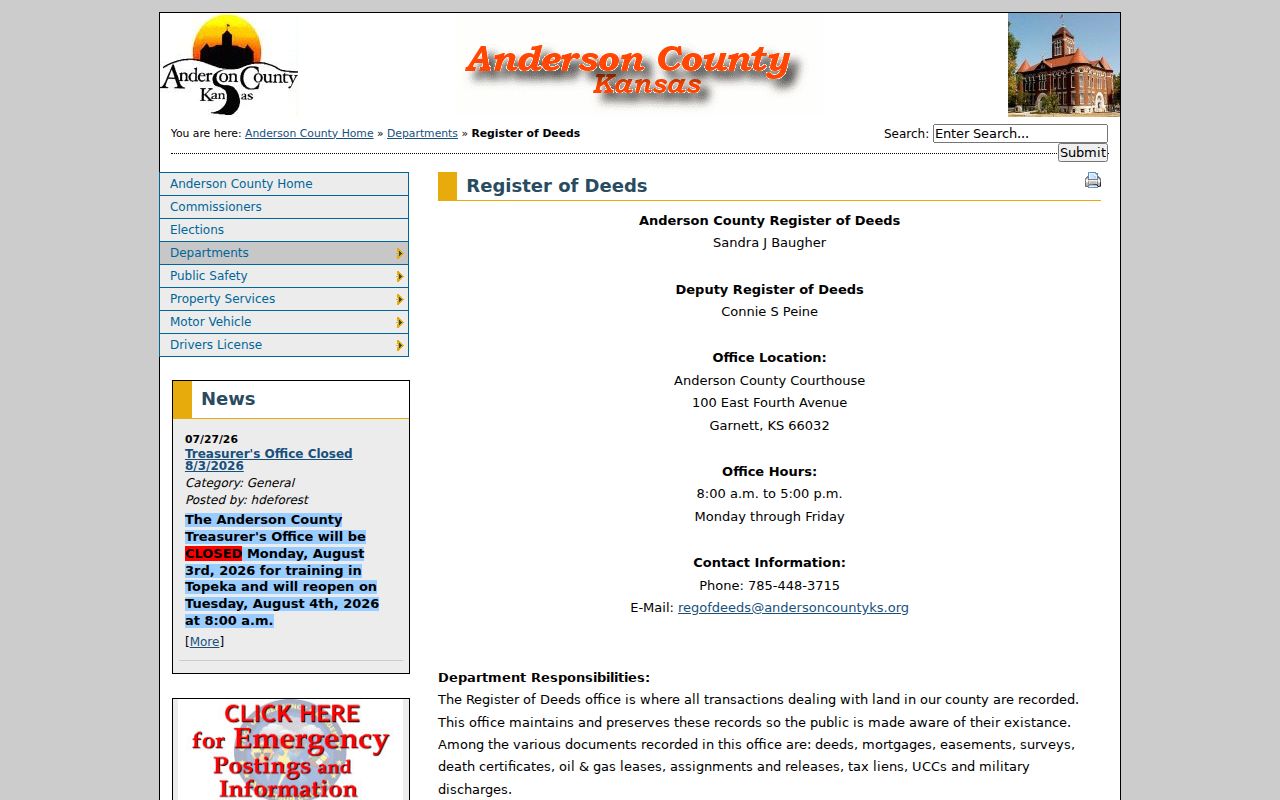
Register Sandra J. Baugher and Deputy Connie S. Peine staff the Register of Deeds office. It sits at the Anderson County Courthouse, 100 East Fourth Avenue, Garnett, Kansas 66032. The office posts Monday through Friday hours of 8:00 a.m. to 5:00 p.m. Callers can reach the desk at 785-448-3715 or email regofdeeds@andersoncountyks.org. These channels matter because Anderson County publishes no online grantor-grantee database for deed records.
Register of Deeds
Recorded deeds, mortgages, easements, surveys, liens, oil and gas instruments, assignments, and releases.
100 East Fourth Avenue
Garnett, KS 66032
785-448-3715
Historical Research
Kansas Historical Society collections hold early deed records and indexes, with access varying by volume and format.
One detail from the Treasurer page is worth noting: the courthouse doors lock at 4:30 p.m., earlier than posted office hours. Call ahead before a late visit. Check temporary county notices before traveling too.
Request Anderson County Deed Copies
A strong copy request gives the recorder enough anchors to pull one instrument quickly. Begin with the property address and exact legal description. KSPID, PropertyID, or QuickRefID work as labeled map references too. Remember, though, that the recorder's own index runs on names, dates, and book/page or instrument numbers. Lean on those when you have them.
- State the current and prior owner names with spelling variants.
- Give the legal description, parcel address, and approximate recording date.
- Name the document type, such as deed, mortgage, easement, survey, or release.
- Ask for the recording date and book/page or instrument reference.
- Specify plain or certified copy and request current fees, postage, payment, and delivery terms.
A phone call or email can settle availability and price before any payment changes hands. A KORA request may obtain an existing image or index entry. Kansas law does not require staff to build a title report or answer legal questions.
Anderson Deed Index Access Gap
The county page links to the Register and a statewide fee schedule. But it offers no live Anderson deed-search screen. There is no supported basis, then, for promising remote name fields, date coverage, instant images, or a set portal fee. The dependable access chain runs through office contact first. From there: counter review. A mail or email request may be accepted. A targeted records request is another route. The official Register of Deeds page posts the current local contact. It also lists the record categories it maintains. Treat that page as the starting point.
The office page is the authoritative handoff. Confirm current search access, copy cost, certification, accepted payment, and turnaround directly before ordering anything.
Build an Anderson Grantor-Grantee Chain
A grantor gives up or transfers an interest in land. A grantee receives it. The grantor-grantee index arranges recorded instruments around those two roles, and each deed ties the parties to a legal description and a recording reference. Chain of title is simply the ordered sequence of transfers affecting the same land.
- Locate the newest deed with the current owner shown as grantee.
- Read the grantor, legal description, recording data, and cited prior deed.
- Search that grantor as an earlier grantee and obtain the matching deed.
- Repeat while checking changes in names, acreage, plats, and parcel splits.
- Review mortgages, releases, easements, court orders, and probate transfers that cross the chain.
- Grantor
- The party transferring the stated interest.
- Grantee
- The party receiving the stated interest.
- Chain of title
- The linked sequence of recorded transfers for the land.
- Book/page
- A volume and page reference for an older recorded document.
- Instrument number
- A unique recorder filing reference used to retrieve a document.
Names alone will not carry the search. Common surnames, trusts, estates, and entity variations invite false matches. The legal description is what keeps a chain anchored to one piece of land.
Early Anderson County Deed Books
The Kansas Historical Society Anderson collection holds deed records from 1857 through 1902. A related index runs from 1857 through 1911. That span gives old-title research a firm starting point. The current county route cannot reach that era online.
The county seat moved from Shannon to Garnett in 1859. Early records may therefore carry an older place name or county-seat context. KSHS land-record guidance also steers researchers toward federal tract books. It points to public-domain patents, plat atlases, railroad materials, and county deed volumes.
Historical access may come through a catalog, microfilm, or a staff-assisted copy. It may not be a digitized page. Include the collection title, series, date span, volume or roll, name, and legal description in every request.
Anderson Deeds, Plats, and Splits
A deed record in Anderson County may point to more than a simple transfer. The instrument could be a plat, a survey, an easement, a road exception, or part of an earlier parent tract. In other words, it may be several of these at once. The county's parcel-split form asks for a certificate of survey, the deed, and a notarized easement when one applies. Its subdivision form adds proposed lots, zoning, ownership details, a preliminary plat where required, notice, and filing steps. Each form is a clue about where the land record trail leads next.
Watch for a change in acreage or a new parcel number on the current record. That shift means the parcel was split, and both sides deserve attention. Compare the old deed description, the recorded survey or plat, the split file, and the newer deed. ORKA geometry can hint at where the line fell. But the legal boundary rests on recorded text and survey evidence alone.
Read every cross-reference in the conveyance. A deed may except a road or reserve minerals. It may transfer only part of a parent tract, or lean on an older survey. Search related recorder categories under both current and prior names. Look there for mortgages, assignments, releases, oil and gas leases, tax liens, and easements. A later satisfaction should name the obligation it ends. Time passing does not prove a recorded burden expired.
The County Engineer keeps road records, rights-of-way, road vacations, and 911 addressing. Those files often explain why deed language about a road differs from today's address. If a map appears to show access, request the public road record or the recorded private easement. GIS geometry alone cannot create a legal right to cross a neighboring tract in Anderson County.
Fees for Anderson Deed Records
The posted Kansas registers-of-deeds schedule sets $21 for the first page of a deed, mortgage, or other writing and $17 for each additional page. Treat that figure as a statewide reference. It does not fix the final local charge for a copy, a staff search, certification, mail, or a specific filing in Anderson County.
Open the Kansas fee schedule to frame the question. Then verify the total with Anderson County directly. Ask whether the request is for recording, a plain copy, or a certified copy. Those are three different services with different costs.
Note: Confirm the Anderson County total and accepted payment method before sending anything, since a statewide schedule is never the final word.
Anderson Estate and Court Transfers
An Anderson County deed chain can break without warning. An owner dies, or a trust changes. A court orders a sale, or an estate conveys the property. The historical probate index spans 1857 through 1976 and works well as a catalog lead. Kansas Courts Smart Search takes a case number, a party or business name, and filters. Courthouse terminals and clerk requests remain solid alternatives.
An obituary or death certificate never transfers real estate by itself. Pair the probate order, executor authority, trustee document, or court judgment with the deed recorded afterward. Restricted vital records must go through lawful channels and only when truly needed.
Some cases are sealed or restricted. Ask the clerk for the public portion and an explanation of what cannot be released. Never infer a court outcome from a filing alone.
Limits of Anderson Deed Records
Recording places an instrument in Anderson County's public land-record system. It does not make every statement true. It clears no prior lien. It settles no boundary dispute. It guarantees no absence of unrecorded interests. A real title opinion demands a fuller examination. Pulling one deed from the property records is not enough.
Recorded, not guaranteed. Anderson County deed records show filed instruments; they are not legal advice, a title opinion, or a boundary survey.
Kansas restricts disclosure of Social Security numbers in public documents, and Safe at Home may supply a substitute address. Use the least personal detail needed. Confirm the latest recording with the custodian before relying on any copy of a deed.